VL-JEPA: The End of Token-by-Token Thinking?
Why predicting every single pixel is a waste of time, and how Meta's new architecture learns to see the big picture.

On this page
Imagine you're watching a movie. You don't pay attention to every single pixel changing color on the screen. You see "a car driving" or "a person waving." Your brain processes concepts, not raw data.
But until now, most Vision-Language Models (VLMs) didn't work like that. They were stuck in the "pixel weeds," trying to reconstruct every tiny detail.
Enter VL-JEPA (Joint Embedding Predictive Architecture). It's Meta's new way of teaching AI to stop obsessing over the details and start understanding the world like we do.
The "Pixel Obsession" Problem
Traditional Generative VLMs work by autoregressively predicting the next token. If you show them a video of a dog running, they try to predict the exact pixels or text tokens that describe it, step-by-step.
Tries to predict every detail (pixels/tokens).
- Slow: Decoding takes forever.
- Inefficient: Wastes compute on irrelevant details (like the exact color of the grass).
Autoregressive (Step-by-Step)
Predicts representations (embeddings) of what happens next.
- Fast: Skips the token generation loop.
- Smart: Focuses only on what matters (semantics).
Non-Autoregressive (All-at-Once)
Why "Latent Space" is the Coolest Place to Be
VL-JEPA operates in Latent Space. Think of "Data Space" as the physical world: pixels, sound waves, letters. It's messy and noisy. "Latent Space" is the world of ideas. In Latent Space, a picture of a "Cat" and the word "Cat" are almost the same point.
VL-JEPA doesn't try to draw the cat; it just predicts where the "Cat idea" will be next.
The Architecture: Under the Hood
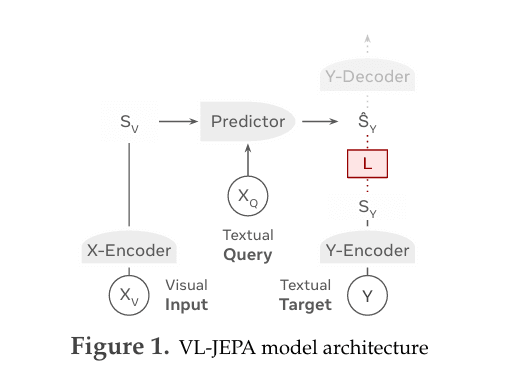
How do you build a machine that thinks in ideas? You need three main parts.
1. The X-Encoder (The Eye)
Based on V-JEPA-2 (ViT-L), this component processes the raw video or image. It cuts the video into time-based chunks and obscures (masks) parts of it. It squashes what it can see into a visual embedding.
2. The Y-Encoder (The Abstract Target)
This is based on EmbeddingGemma-300M. It takes the target text (the answer) and converts it into a semantic embedding. Crucially, during training, this encoder is "lazy" (updated slowly via EMA) to ensure stable targets. The model never sees the text directly! It has to guess this embedding.
3. The Predictor (The Brain)
Built from LLaMA-3.2-1B layers, this transformer takes the visual embedding (from X) and a text query, and tries to predict the Y-embedding.
The Training Game: Hide and Seek
The training uses an InfoNCE Loss function.
- Alignment: The model's guess () must be close to the real target ().
- Uniformity: The guess must not look like other random things.
This prevents "Representation Collapse," where the model just outputs the same generic "blur" for everything to play it safe.
Two Steps to Intelligence
You don't just wake up knowing physics. You learn to walk first. VL-JEPA follows a similar rigorous two-stage training process.
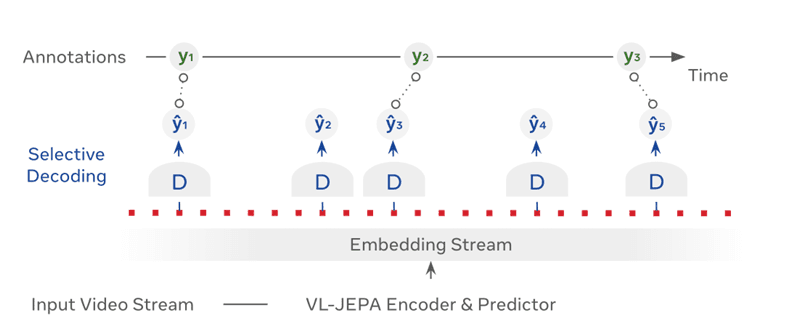
The Killer Feature: "Selective Decoding"
This is where VL-JEPA keeps its mouth shut until it has something to say. Standard models babble. They decode text constantly. VL-JEPA monitors the embedding stream.
If the embedding hasn't changed much, it means the "situation" hasn't changed. So it doesn't bother decoding text. It only "speaks" (decodes) when it detects a significant shift in meaning.
The Result?
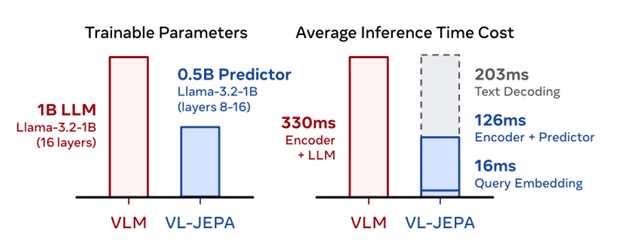
- 3x Faster inference.
- Far less computation.
- Real-time understanding without the lag.
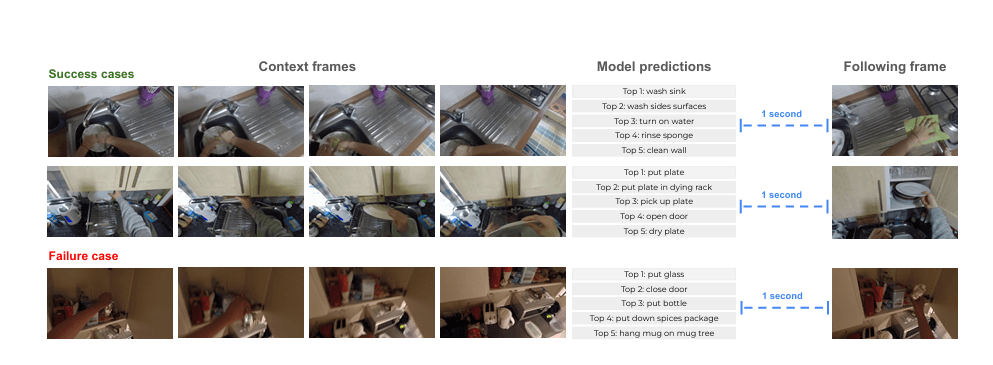
The Scorecard: Does it actually work?
It’s not just theory. When put to the test, VL-JEPA holds its own against massive, compute-hungry models.
Conclusion
VL-JEPA proves that we don't need to simulate every atom of the universe to understand it. By teaching AI to predict representations instead of observation, Meta has built a system that is faster, smarter, and eerily closer to how our own brains work.
It's not just a language model anymore. It's a Thought Model.