Attention is All You Need
An in-depth analysis of 'Attention Is All You Need' and the genesis of Large Language Models.

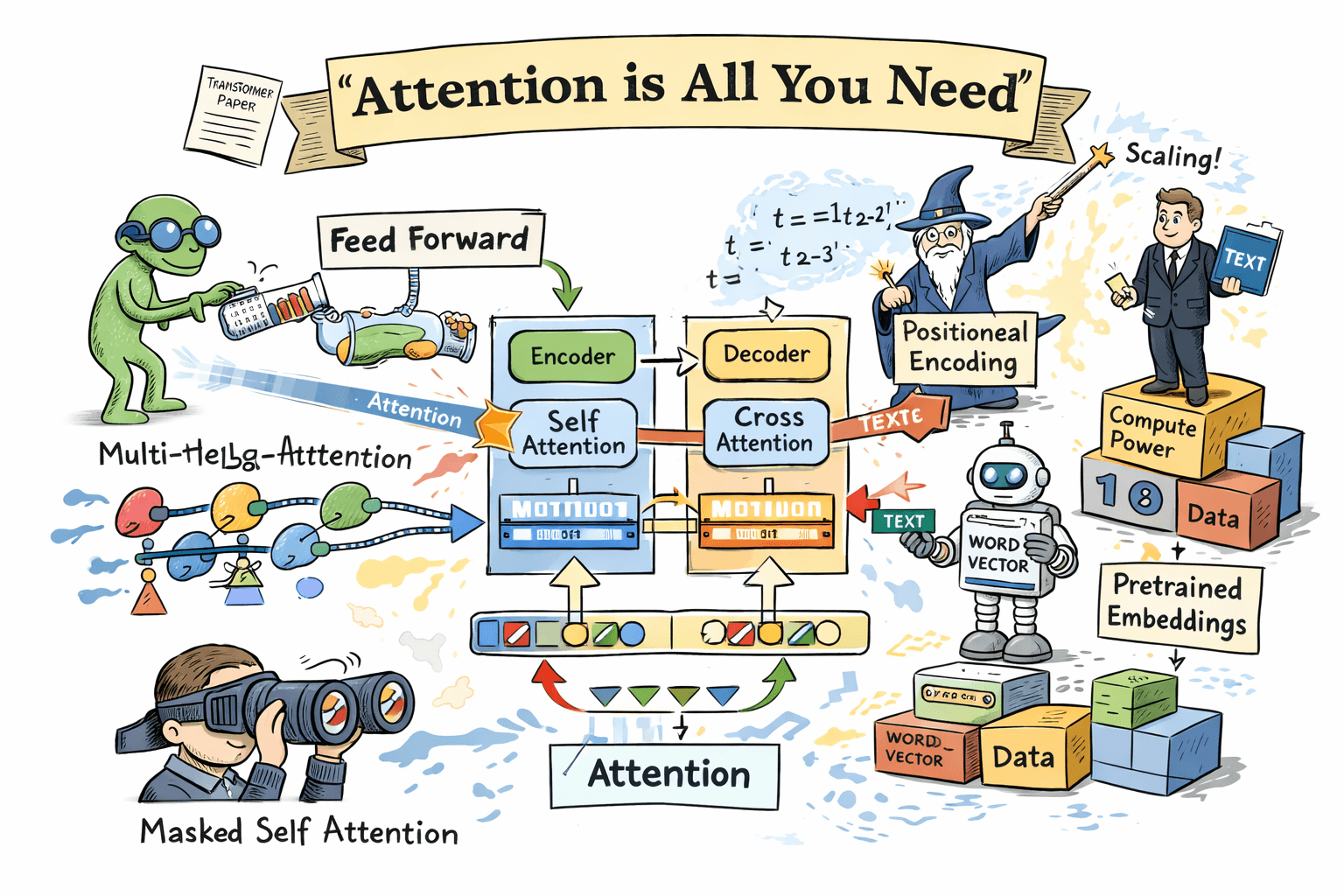
On this page
Summary
In June 2017, the landscape of artificial intelligence underwent a seismic shift with the publication of "Attention Is All You Need" by researchers at Google Brain. This paper introduced the Transformer, a neural network architecture that dispensed with the recurrent and convolutional layers that had defined the state of the art in Natural Language Processing (NLP) for decades.
By relying entirely on a mechanism known as Self-Attention, the Transformer solved the fundamental bottlenecks of sequential processing, enabling the parallel training of models on data at the scale of the entire internet.
The Pre-Transformer Era
Prior to 2017, the field of sequence modeling—which includes machine translation, text summarization, and speech recognition—was dominated by sequential architectures, primarily Recurrent Neural Networks (RNNs) and their more advanced variants, LSTMs and Gated Recurrent Units (GRUs).
Recurrence
The RNNs worked by processing the human language as a stream of information unfolding over time. They were just an imitation of how humans read a sentence. When a human reads a sentence, they do not perceive the entire text instantly; they process it word by word, accumulating meaning as they go.
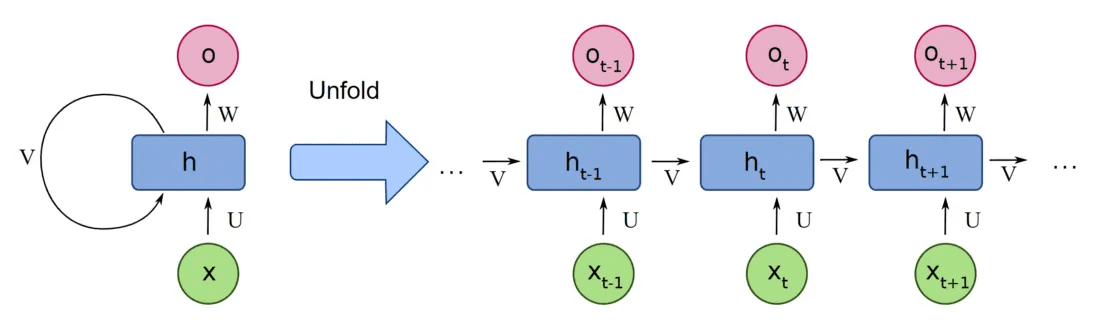
Mechanically, an RNN processes a sequence (x_1, x_2,..., x_n) by maintaining a "hidden state" h_t. This hidden state acts as the network's short-term memory. At each time step t, the network computes the new hidden state h_t based on two inputs:
- The current input token
x_t(e.g., the word currently being read). - The previous hidden state
h_{t-1}(the memory of what was read previously).
This recursive relationship can be expressed mathematically as:
This formulation meant that the computation at step t was theoretically dependent on all previous steps. To understand the last word of a sentence, the network had to have successfully propagated information from the first word through every intervening step.
The Bottleneck
The sequential nature of RNNs were no scalable. Because the calculation of the current state h_t strictly required the output of the previous state h_{t-1}, processing could not be parallelized. The network had to wait for step 1 to finish before starting step 2, and for step 2 to finish before starting step 3.
Graphics Processing Units (GPUs), are designed for massive parallelism—they excel at performing thousands of calculations simultaneously. RNNs forced the GPU to operate sequentially, leaving vast amounts of computational power idle. Training on large datasets took prohibitively long times, effectively capping the amount of data a model could learn from.
The Memory Problem
During the training process, neural networks learn by "backpropagation"—calculating the error of the model's output and propagating it backward through the network to update the weights. In an RNN, this error signal must travel backward through time, from the end of the sentence to the beginning.
However, as the signal travels backward, it is repeatedly multiplied by the network's weight matrices. If these weights are small (less than 1), the error signal diminishes exponentially with each step, much like repeatedly multiplying . For long sequences, the signal from the end of the sentence would essentially "vanish" before it reached the beginning.
LSTMs (Long Short-Term Memory networks) were introduced to mitigate this by adding "gates" that allowed the network to selectively keep or forget information, extending the effective memory. However, while LSTMs improved performance, they did not solve the fundamental sequential processing bottleneck.
No matter how much data or compute you threw at them:
- training didn’t scale cleanly
- long documents collapsed
- parallel hardware was underused
Comparison of Pre-Transformer Architectures
The following table summarizes the limitations of the dominant architectures prior to the introduction of the Transformer.
The Paradigm Shift
In 2017, Vaswani et al. published "Attention Is All You Need," proposing a radical simplification. They hypothesized that the recurrent and convolutional structures—considered the backbone of sequence modeling—were unnecessary complications. Instead, they proposed that Attention mechanisms, previously used only as a supplementary component to RNNs, could serve as the sole foundation for sequence transduction.
The Core Thesis
The paper's title is literal: the authors demonstrated that a simple network architecture based only on attention could outperform complex recurrent models. They named this architecture the Transformer.
The Transformer fundamentally altered how relationships between words were calculated. Instead of processing a sentence linearly (left-to-right), the Transformer processes the entire sequence simultaneously. It uses an attention mechanism to calculate the relationship between every word and every other word in the sequence in a single operation.
This shift had two profound consequences:
- Constant Path Length: The "distance" between any two words in a sentence became 1. The subject at position 1 and the verb at position 100 were just as "close" to each other computationally as two adjacent words. This solved the long-range dependency problem.
- Massive Parallelism: Since the calculation for word 5 did not depend on the completed calculation of word 4, the entire sequence could be processed in parallel. This unlocked the full potential of modern GPU hardware, allowing for training on vastly larger datasets.
What Transformers Changed Philosophically
- Old belief: "Understanding comes from remembering the past."
- Transformer belief: "Understanding comes from comparing everything to everything else."
That shift:
- removed sequence dependency
- unlocked parallelism
- allowed extreme depth
- made foundation models possible
Wait, what are Encoders and Decoders?
Before we look at the math, let's simplify.
Imagine a Fancy Restaurant.
The Encoder (The Waiter): The waiter takes your complex, messy order ("I want the burger, no onions, extra pickles, and can you make it medium-rare but closer to medium?"). He doesn't just write down words; he encodes your chaotic request into a neat, standardized ticket that the kitchen understands perfectly. He captures the meaning of what you want.
The Decoder (The Chef): The chef takes that standardized ticket (the representation) and produces the actual meal, one step at a time. She doesn't need to hear your voice; she just needs the encoded information to generate the output.
- Encoder = "Understand the input and compress it into meaning." (Reading, Listening)
- Decoder = "Take meaning and generate output." (Writing, Speaking)
The Architecture
The Transformer is an Encoder-Decoder architecture, though later LLMs would often utilize only one of these halves. To understand the modern AI boom, one must understand the specific components that make up this machine.
Self-Attention
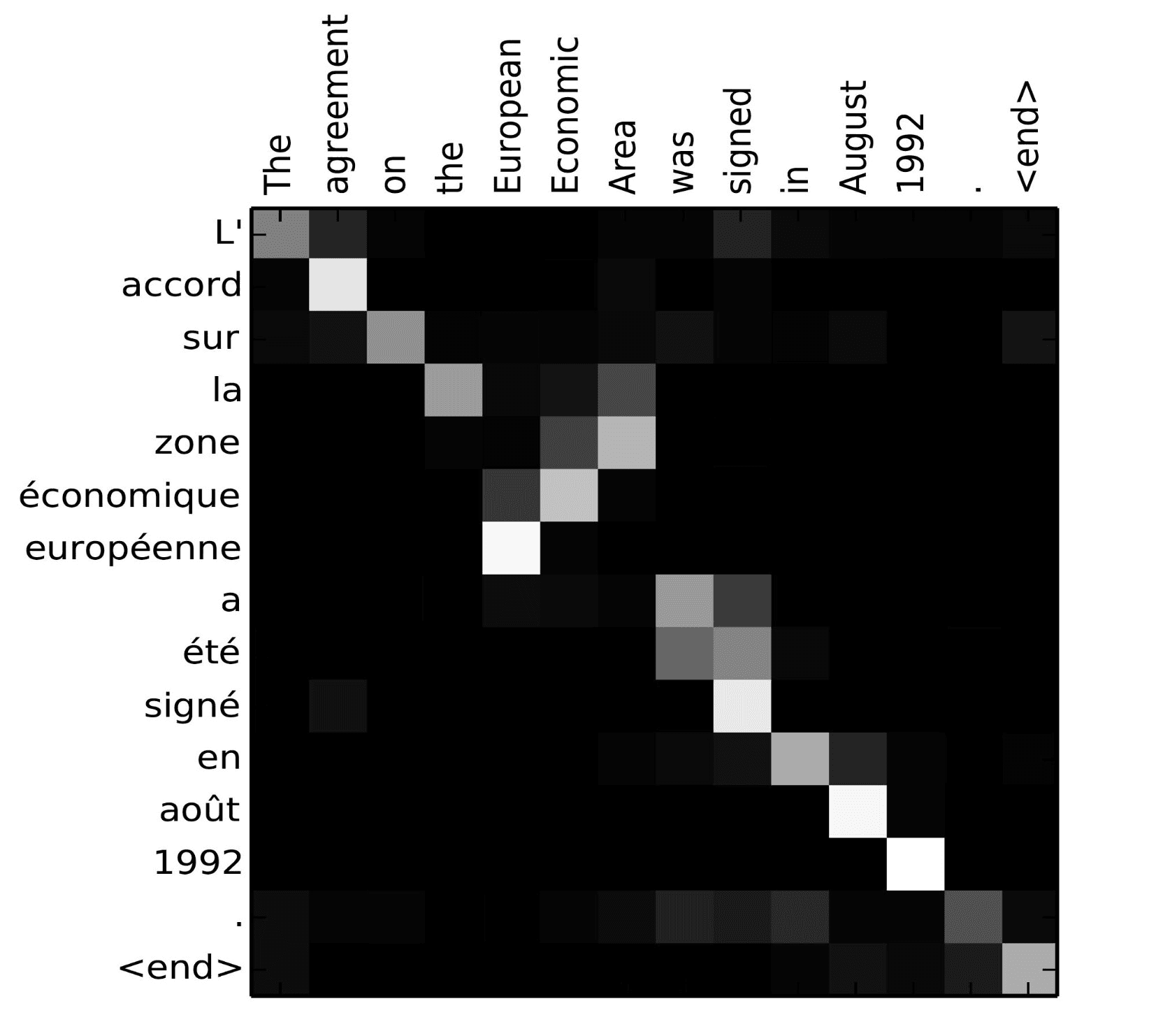
Self-Attention is the engine of the Transformer. It is the mechanism by which the model decides "how much attention" to pay to other parts of the input when processing a specific part.
When the model processes the word "bank" in the sentence "I arrived at the river bank," self-attention allows it to look at the word "river" to understand that "bank" refers to the side of a body of water, rather than a financial institution.
The Query, Key, and Value (QKV) Model
This visualization demonstrates a BERT model processing two sentences. Notice how the attention mechanism operates: when the tokens "when", "was", and "released" are highlighted, the model's attention strongly focuses on "2017" in the second sentence. This illustrates the model's ability to resolve temporal context and link related information across sentence boundaries.
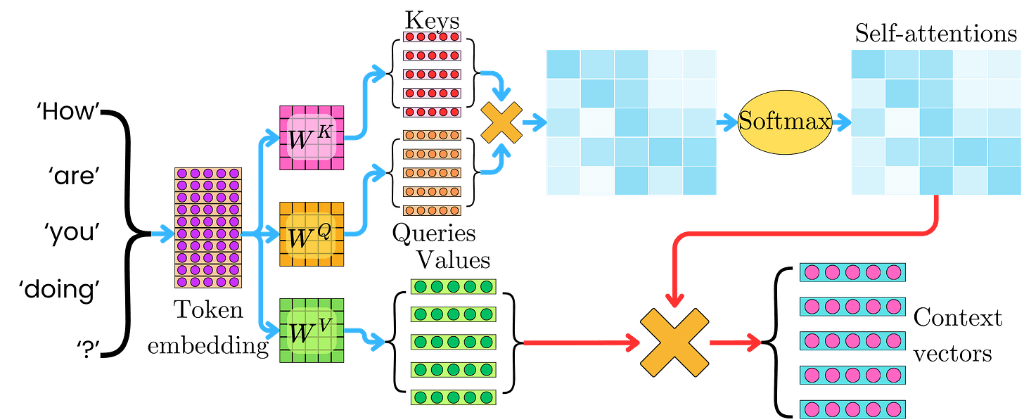
To implement this mathematically, the authors introduced the Query-Key-Value concept, often explained using a database retrieval analogy.
For every token (word) in the input, the model creates three distinct vectors:
- Query (Q): Represents the token's "search intent." It asks, "What kind of information am I looking for to understand myself?"
- Key (K): Represents the token's "identity." It advertises, "Here is what I define; match with me if you need this info."
- Value (V): Represents the token's "content." It says, "If you match with my Key, here is the actual information I will give you."
The Cocktail Party Analogy
Imagine you are at a crowded party. You (the Query) want to talk about "Neural Networks." You shout this topic out to the room. Everyone in the room holds a sign listing their interests (the Keys). You scan the room and compare your query ("Neural Networks") with everyone's keys.
- Person A's sign says "Cooking." (Low match).
- Person B's sign says "Deep Learning." (High match).
- Person C's sign says "Sports." (Low match).
You focus your attention primarily on Person B. Person B then speaks and gives you their knowledge (the Value). You "attend" to Person B's value much more than Person A or C.
The Math
The Transformer performs this "matching" process using a dot product between the Query and Key vectors. A high dot product indicates high similarity (alignment).
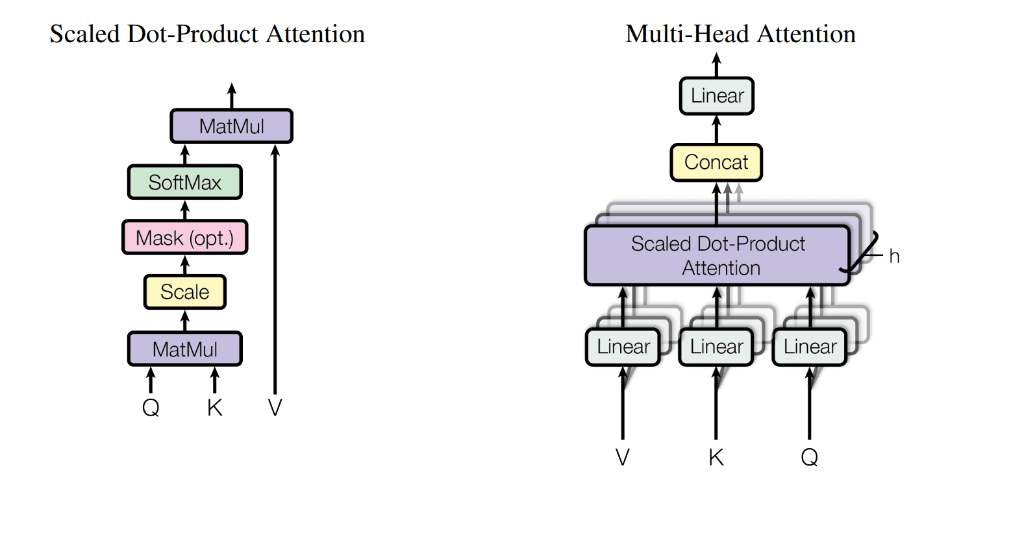
The formula for Scaled Dot-Product Attention is:
Attention(Q, K, V) = softmax( (Q * K^T) / sqrt(d_k) ) * V
QK^T(Dot Product): Computes the similarity score between the Query and all Keys.sqrt(d_k)(Scaling): The scores are divided by the square root of the dimension of the key vectors. This prevents the dot products from becoming too large, which would push the softmax function into regions with extremely small gradients.- Softmax: This function normalizes the scores so they all add up to 1 (or 100%). This converts raw scores into probabilities, determining exactly how much of each Value vector to include.
V(Multiplication): Finally, the Values are weighted by these probabilities and summed together.
The result is a new vector for the word that is a weighted combination of all relevant context from the rest of the sentence.
Multi-Head Attention
A single attention calculation might focus on one type of relationship (e.g., matching a subject to a verb). However, language is complex; a word has grammatical roles, semantic meanings, and tonal implications simultaneously.
To address this, Vaswani et al. introduced Multi-Head Attention. Instead of running the QKV process once, the model runs it multiple times in parallel, with each "head" maintaining its own separate weight matrices.
Analogy: The Editors' Committee
Imagine a team of editors reviewing a sentence.
- Editor 1 (Head 1) focuses solely on grammar and syntax.
- Editor 2 (Head 2) focuses on emotional tone and sentiment.
- Editor 3 (Head 3) focuses on pronoun antecedents (who is "he"?).
- Editor 4 (Head 4) focuses on vocabulary definitions.
Each head produces its own output vector. These outputs are then concatenated (stitched together) and passed through a linear transformation. This allows the Transformer to capture different nuances of language simultaneously, providing a much richer representation than a single attention pass could achieve.
Positional Encoding
One side effect of the Transformer's parallel processing is that it is permutation invariant. Because it looks at all words simultaneously, it does not inherently know the order of words. To the Transformer, "The dog bit the man" and "The man bit the dog" look identical because they contain the same set of words.
This is a stark contrast to RNNs, where order is baked into the sequential processing structure. To solve this, the authors injected information about the position of each token directly into the input embeddings via Positional Encodings.
The paper utilized a unique approach using sine and cosine functions of different frequencies. This encoding acts like a timestamp or a shelf label added to the content of the book, allowing the model to understand "where" a word is located even while processing the entire "library" at once.
The Architecture Split: Encoder vs. Decoder
The original Transformer was designed for Machine Translation (e.g., English to French). To do this well, you need two distinct phases: understanding the source and generating the target.
The Encoder: The Expert Reader
- Job: Read the entire input sentence at once.
- Superpower: Bidirectional Attention. It can look at the word "bank" and look at "river" (to the left) and "water" (to the right) simultaneously to understand context.
- Output: It doesn't output text. It outputs a "Context Matrix"—a mathematical map of the sentence's meaning.
The Decoder: The Creative Writer
- Job: Write the translated sentence, one word at a time.
- Limitation: Unidirectional Attention. When writing the 3rd word, it can only see the 1st and 2nd words. It cannot look at the 4th word because it hasn't written it yet!
- Connection: It uses Cross-Attention to look back at the Encoder's "Context Matrix" for guidance before choosing the next word.
Masked Self-Attention: Preventing "Cheating"
If the Decoder's job is to predict the next word, we have a problem during training.
When we train the model, we give it the full target sentence like "The cat sat on the mat." We ask it to predict "sat" given "The cat".
However, because the Transformer processes everything in parallel, the model could theoretically "peek" at the word "sat" in the input data while trying to guess it. This would be like a student looking at the answer key before solving the math problem—they get 100% accuracy but learn nothing.
The Solution: The Mask To stop this, we apply a mathematical blindfold called a Mask.
- Take the attention scores for all future words (positions the model shouldn't see).
- Set them to negative infinity (
-infinity). - When Softmax is applied, these turn to
0.
This forces the model to rely only on the past words and the Encoder's context map to perform its prediction, physically preventing it from cheating.
Life of a Token
To understand how modern LLMs (like ChatGPT) work, let's trace the generation of a single word. Imagine the model is trying to complete the sentence: "The robot is..."
Goal: Predict the next word.
Step 1: Input Processing
- Tokenization: The phrase "The robot is" is broken into token IDs (e.g.,
[464, 12903, 318]). - Embedding: These IDs are converted into vectors.
- Positional Encoding: Time-stamps are added so the model knows "The" came before "robot".
Step 2: The Decoder Stack (The Brain)
The vectors enter the Decoder. Since this is text generation (GPT-style), there is no separate Encoder to look at. The Decoder does all the work.
- Masked Self-Attention:
- The model looks at "is" (the current position).
- It looks back at "robot" and "The" to understand the subject.
- Result: It builds a context vector that represents "a singular subject (robot) exists".
- Feed-Forward Network (FFN):
- The model accesses its internal memory. It recalls facts about robots: "they are mechanical," "they are intelligent," "they are machines."
- Result: The vector is refined to favor adjectives or nouns related to robot traits.
(Note: In a full Encoder-Decoder model like the original Transformer, there would be a "Cross-Attention" step here to check the source text, but for pure generation, we skip this).
Step 3: The Prediction (Output)
The refined vector passes through the final Linear Layer and Softmax.
- Result (Probability Distribution):
- "intelligent": 15%
- "sentient": 5%
- "friendly": 10%
- "functioning": 60%
- Selection: The model picks "functioning".
The sentence becomes "The robot is functioning," and the process repeats to generate the next word.
The LLM Revolution
The user's query asks how these innovations "marked the taking of the LLMs." The transition from the Transformer paper to the age of ChatGPT was not immediate, but it was a direct causal result of the architectural choices made in 2017. The Transformer didn't just improve performance; it changed the economics and scalability of AI.
Parallelization and the Data Explosion
The primary catalyst for the LLM revolution was the removal of the sequential bottleneck. With RNNs, training on massive datasets was practically impossible because the training time scaled linearly with sequence length.
The Transformer's parallel architecture meant that training speed was no longer bound by the length of the sentence, but rather by the amount of compute (GPUs) available. This shift allowed researchers to move from training on curated datasets (like Wikipedia) to training on web-scale datasets (like Common Crawl, essentially the entire text of the public internet).
The Data-Compute Feedback Loop:
- Transformers allowed parallel training on thousands of GPUs.
- This allowed models to ingest terabytes of data.
- Ingesting terabytes of data required larger models (more parameters) to store the information.
- Larger models showed better performance, justifying further investment in compute.
The Divergence: Encoders (BERT) and Decoders (GPT)
Following the "Attention Is All You Need" paper, the research community realized that for many tasks, the full Encoder-Decoder architecture was unnecessary. This led to a bifurcation that defined the early LLM era.
The Encoder-Only Branch: BERT (2018)
Google introduced BERT (Bidirectional Encoder Representations from Transformers), which used only the Encoder stack.
- Goal: Understanding.
- Mechanism: "Masked Language Modeling." It hides a word in the middle of a sentence ("The sat on the mat") and asks the model to guess it using context from both left and right.
- Impact: Revolutionized search, sentiment analysis, and classification.
The Decoder-Only Branch: GPT (2018)
OpenAI introduced GPT (Generative Pre-trained Transformer), which used only the Decoder stack.
- Goal: Generation.
- Mechanism: "Next Token Prediction." Given a sequence of words, predict the next one.
- Why drop the Encoder?: For generative tasks, the bidirectional context is not available during inference (you can't see the future words you haven't written yet). The Decoder-only architecture, with its masked attention, was perfectly suited for this "autoregressive" task.
Why GPT Won the LLM Race: While BERT was initially more popular for commercial tasks (like search), the Decoder-Only architecture proved to be more scalable for general intelligence. The task of "predicting the next word" turned out to be a proxy for reasoning. To accurately predict the next word in a complex essay, legal argument, or code snippet, the model forced itself to learn logic, syntax, world knowledge, and causality.
The Modern Landscape: Who Uses What?
Here is how today's famous models align with the Transformer architecture:
Scaling Laws and Emergence
Perhaps the most significant legacy of the Transformer is the discovery of Scaling Laws. Researchers (notably Kaplan et al. at OpenAI) found that with the Transformer architecture, performance improves via a predictable power law with respect to model size, dataset size, and compute.
This predictability gave organizations the confidence to train models of unprecedented size.
- GPT-1 (2018): 117 million parameters.
- GPT-2 (2019): 1.5 billion parameters.
- GPT-3 (2020): 175 billion parameters.
- GPT-4 (2023): Estimated in the trillions.
As these models scaled, they exhibited Emergent Capabilities—abilities that were not explicitly trained. A model trained only to complete text suddenly demonstrated the ability to translate languages, write Python code, solve math problems, and summarize articles. These capabilities "emerged" purely from the scale of data and parameters enabled by the Transformer architecture.
Impact & Future
The "Attention Is All You Need" paper did more than just improve translation scores; it provided the "foundation" for Foundation Models.
Beyond Text: The Universal Architecture
The mechanism of attention proved to be data-agnostic. The "token" in a Transformer does not have to be a word.
- Vision Transformers (ViT): Treat an image as a sequence of "patches" (visual words). Self-attention allows the model to learn global relationships between pixels, outperforming CNNs in many tasks.
- AlphaFold: DeepMind used the Transformer architecture to solve the "protein folding problem," predicting 3D protein structures from amino acid sequences. The amino acids are treated as tokens, and attention models the chemical interactions between them.
- Multimodality: Modern models (like GPT-4o or Gemini) can process text, audio, and images simultaneously because the Transformer architecture unifies them all into a common vector space.
The "Foundation Model" Paradigm
Before Transformers, AI was "narrow." You trained one model for translation, another for summarization, and another for sentiment analysis.
The Transformer enabled the Foundation Model paradigm: train one massive model on a massive dataset (Pre-training), and it learns a general representation of the world. This single model can then be adapted (Fine-tuned) for thousands of different downstream tasks.
Conclusion
The publication of "Attention Is All You Need" stands as a watershed moment in the history of computer science. By successfully challenging the assumption that recurrence was necessary for sequence modeling, Vaswani et al. unlocked a new regime of computation.
The paper introduced three critical innovations:
- Self-Attention: A mechanism to model global dependencies in constant time, replacing the "fading memory" of RNNs.
- Multi-Head Attention: A method to capture multiple types of linguistic relationships simultaneously.
- Parallel Architecture: A design that allowed training to scale with available hardware rather than sequence length.
These innovations directly "marked the taking of the LLMs" by removing the ceiling on dataset size and model complexity. The Transformer converted the abstract concept of "learning from the internet" into a concrete engineering reality. From the early experiments with BERT and GPT-1 to the massive reasoning engines of today, the lineage is unbroken. Every major LLM today is, at its core, a Transformer, proving the authors' bold title correct: Attention really was all we needed.